Author

Streamline

Sharing a bathroom can become frustrating when two people need the same sink, mirror, or countertop at the same time. Morning routines often involve overlapping activities, making efficient bathroom design particularly important for couples and families.

Installing a double bathroom vanity can help create separate grooming areas while offering additional storage. However, simply adding another sink does not guarantee a more functional bathroom. The available space, cabinet configuration, and daily habits of the people using the room should guide the design.

Two Sinks Do Not Automatically Mean Better Functionality

A double-sink arrangement is often associated with large primary bathrooms. Although having two basins can reduce competition for sink access, the layout must provide enough room for both people to move comfortably.

If the sinks are positioned too closely together, users may still interfere with one another during morning routines. Countertop space around each basin also affects how easily grooming products can be used.

Cabinet width should therefore be evaluated alongside sink spacing. The goal is to create two genuinely usable areas rather than simply fitting two basins into the available furniture.

Understanding the Space Required

Before selecting a double-sink configuration, homeowners should measure the entire bathroom and identify areas where movement could become restricted.

Vanities measuring approximately 60 or 72 inches wide are common options for shared bathrooms, although specific models and sink arrangements vary. Larger configurations may offer greater separation and storage.

The room must also accommodate door movement, nearby fixtures, and comfortable access to drawers. A wide cabinet can create difficulties when placed near a shower enclosure or toilet.

Using floor measurements and a simple layout drawing helps determine whether the proposed cabinet improves the bathroom or makes circulation more difficult.

Storage Needs Become More Complicated in Shared Bathrooms

When two people use the same bathroom, storage can quickly become disorganized. Grooming products, medications, towels, and personal accessories may compete for limited cabinet space.

A well-designed vanity can provide separate storage areas, allowing each person to organize frequently used belongings independently.

Drawers are often convenient for small items, while larger cabinets can accommodate cleaning products or spare toiletries. Adjustable shelves may help accommodate containers of different heights.

The best arrangement depends on individual habits. Dividing storage logically can reduce clutter and prevent the countertop from becoming a permanent collection of everyday products.

The Countertop Needs Careful Planning

Two sinks occupy more surface area than one, potentially reducing the amount of uninterrupted countertop space available.

Homeowners should examine how much usable space remains between the basins and near the outside edges. This becomes especially important when both people regularly use grooming appliances or cosmetics.

Countertop materials also influence maintenance. Water splashes, toothpaste, soap residue, and cosmetic spills may occur more frequently when two people use the space simultaneously.

Selecting a surface with appropriate care requirements can help keep the bathroom manageable without demanding excessive cleaning.

Plumbing Considerations Can Affect the Budget

Installing two sinks requires suitable water supply and drainage connections. Whether existing plumbing can accommodate the arrangement depends on the bathroom’s layout and current installation.

Replacing an existing double-sink cabinet may be relatively straightforward when the new unit matches the connections. Converting a single-sink bathroom can involve more substantial plumbing work.

These modifications should be evaluated by a qualified professional before purchasing the vanity. Cabinet drawers and internal partitions may also influence how pipes can be routed.

Understanding these requirements early helps homeowners develop a realistic renovation budget and avoid unexpected installation delays.

Mirrors and Lighting Should Serve Both Users

A shared bathroom needs lighting that supports simultaneous grooming activities. One poorly positioned overhead fixture may produce uneven illumination or unwanted shadows.

Two separate mirrors can create clearly defined personal areas. Alternatively, a single wide mirror may establish a continuous appearance across the cabinet.

Both arrangements can work effectively when their proportions suit the vanity and the surrounding wall.

Lighting should provide adequate visibility at each sink rather than prioritizing symmetry alone. Appropriately positioned fixtures can improve everyday usability while complementing the room’s overall design.

Designing for Changing Household Needs

Bathroom requirements may change as families grow or daily schedules become more demanding. A shared bathroom that works for two adults today might eventually accommodate children or visiting relatives.

Flexible storage helps the room adapt without requiring immediate furniture replacement. Neutral finishes and practical cabinet layouts may also remain relevant as decorating preferences evolve.

Durable hardware, accessible drawers, and manageable countertop surfaces contribute to a bathroom that performs well under changing conditions.

Instead of designing around a temporary trend, homeowners can prioritize features that simplify routines over many years.

Conclusion

A successful shared bathroom depends on more than installing two sinks. Comfortable spacing, organized storage, appropriate plumbing, and balanced lighting all contribute to a practical design. Bathroom Vanities Outlet offers double-sink vanity configurations that homeowners can consider when planning a bathroom that supports multiple users without sacrificing comfort or visual appeal.


0 comments
0 FacebookTwitterPinterestEmail

A price is never just a feeling. Behind every good listing sits a pile of numbers, checked and rechecked. Skilled real estate agents and brokers read those numbers the way a farmer reads the sky. They look for patterns, then they act on them.

Get the price wrong and the home sits. Get it right and offers arrive quickly. That is why data matters so much. This guide shows what information professionals use, where it comes from, and how you can ask smarter questions before you list or buy.

Why Accurate Pricing Matters Most

Price is the first thing buyers see. Too high, and they scroll past. Too low, and you leave money on the table. Both mistakes hurt, though the first one often drags on longer because the listing goes stale.

Experts aim for a sweet spot. A fair price draws more viewings in the first two weeks, which is when interest peaks. After that, buyers start wondering what is wrong. Smart pricing from day one protects your time and your final figure.

Main Sources of Reliable Information

Professionals pull from several places. The Land Registry shows sold prices across England and Wales. Rightmove and Zoopla show asking prices and how long homes stayed listed. Council sites add planning records and tax bands.

Energy performance certificates help too, since they reveal size and efficiency. No single source tells the whole story. Good agents blend them, then cross check anything that looks odd. A strange number is often just a typing slip, but you must verify it.

Comparing Similar Homes Nearby

The heart of pricing is the comparison. Agents pick homes of similar size, age, and condition within a short distance. They look at what those homes actually sold for, not what sellers hoped for.

Details count here. A south facing garden, a parking space, or a loft room can shift value by thousands. Agents adjust the figures up or down for each difference. Ask to see the list of comparable homes they used. A fair professional will happily share it.

Tracking Local Market Trends Closely

One sale tells you little. A year of sales tells you far more. Agents watch how prices move month by month, how many homes come to market, and how many buyers are searching.

Fast moving areas need fresh checks, sometimes weekly. Interest rates, new transport links, and school ratings can all change demand. Reliable property data shows these shifts early, which lets agents advise on timing as well as price.

Using Technology and Valuation Tools

Modern firms use software that scans thousands of sales in seconds. Automated valuation tools give a rough starting figure. They are quick, but they cannot see a leaking roof or a stunning view.

That is where human judgment steps in. The agent visits, notices the condition, and adjusts the number. Treat online estimates as a first step only. A real visit, with real eyes, always gives a sharper answer than a website alone.

Spotting Limits and Common Errors

Data can mislead. Old figures, wrong addresses, and rare one off sales can skew results. A home sold at auction or to a relative may not reflect true market value at all.

Good professionals know these traps. They question strange numbers and avoid leaning on a single record. As a client, ask how they checked their figures. Clear answers show care. Fuzzy ones suggest the price was picked in a hurry.

Conclusion

Accurate pricing comes from facts, comparison, and local insight. Professionals gather records, study trends, use tools, and then add their own judgment. Each step guards against costly mistakes. When you understand the process, you can judge the advice you receive.

For more help with your next property move, visit nestlink.io and explore useful guidance. Ask your agent to show the numbers behind every price. Good professionals welcome that request, because clear data builds trust and trust leads to better deals.

0 comments
0 FacebookTwitterPinterestEmail

Storm trips can mean long hours on the road, quick stops, and plenty of time watching the sky. Good seating matters more than many travelers expect. On tornado tours 2027, a comfortable seat can make a full day feel much easier. You may spend hours moving between viewing areas while weather teams track changing conditions. A well-planned tour should offer more than exciting views. It should also give guests a smooth ride, enough room, and useful breaks. Small comfort details can make a big difference when the day runs long.

Comfort Matters During Long Storm Drives

Storm chasing often means covering many miles before reaching the right viewing area. That makes seat comfort a key part of the trip. Firm support can help reduce tiredness during long drives, while enough legroom gives passengers space to move. Seats with good back support are also helpful when roads are busy or travel takes longer than planned. Tour vehicles may vary, from roomy vans to larger passenger vehicles. Checking the seating setup before booking can help travelers choose a trip that suits their needs and keeps the journey pleasant from start to finish.

Roomy Seating Helps Travelers Relax

Long drives feel different when passengers have enough personal space. A roomy seat allows small movements, easy access to bags, and a more relaxed ride. This matters on Kansas storm chasing tours 2027, where travelers may move between several viewing spots during one outing. Clear seating plans can also help groups sit together when space allows. Families, friends, and solo travelers may have different needs. Asking about vehicle size, seat spacing, and storage before departure is a smart step. It takes only a minute, yet it can improve comfort throughout a busy storm-chasing day.

Vehicle Choice Can Change Comfort

The type of vehicle used for a storm tour can shape the whole travel experience. A spacious van may offer easier movement, while a larger vehicle can provide more room for several passengers. Good airflow is useful too, especially during warm weather. Clean seats, working seat belts, and clear windows should also be part of the basic setup. Travelers booking tornado tours 2027 can ask what vehicle is normally used and how many guests share it. That simple check gives a better idea of personal space before the trip begins.

Smart Seating Tips Before Booking

A few simple checks can prevent discomfort later. Travelers should ask whether seats are assigned, shared, or chosen on arrival. It is also useful to know if the vehicle has adjustable seats or enough space for taller guests. People who need extra room may want to mention this before booking. Bags should have a safe storage place, too. Storm trips can involve cameras, jackets, snacks, and other gear. A neat seating area makes it easier to settle in. These small details often matter most after several hours on the road.

Breaks Make Long Trips Easier

Even the best seat cannot replace regular breaks. Long storm tours are easier when travelers can stretch, walk, eat, and refresh during planned stops. Breaks also give guests time to check weather updates, take photos, or simply enjoy the changing landscape. A good tour plan should balance driving with useful pauses. This is especially important when weather conditions shift and travel routes change. Comfortable seating and sensible breaks work together. One supports the body during travel, while the other gives travelers a chance to reset before getting back on the road.

Comfort Adds Value to Storm Tours

A storm tour is about seeing powerful weather, but the journey between viewing areas is part of the experience too. Comfortable seating, enough space, safe vehicles, and sensible breaks can make long travel days far more enjoyable. Travelers comparing Kansas storm chasing tours 2027 should look beyond the main attraction and check the practical details before booking. A little planning can help avoid tiredness and discomfort later. For travelers seeking a well-organized storm chasing experience, stormchasing.com can be a useful place to explore available tour information and plan.

Conclusion

Comfort should never be an afterthought on a full day of storm chasing. The right seat, enough legroom, clean surroundings, and regular breaks can make hours on the road much easier. Travelers should check the vehicle, seating layout, storage space, and break schedule before choosing a tour. These details may seem small at first, but they become important during a long day outdoors. Anyone planning a future storm adventure can review options at stormchasing.com and choose a trip that offers both exciting weather views and a more comfortable travel experience.

0 comments
0 FacebookTwitterPinterestEmail

A da score can look like a simple grade for a website, but it is better understood as one clue among several. Businesses use authority metrics when comparing sites for partnerships, guest posts, and link building. Freelancers may encounter them when assessing a client’s online presence or planning a marketing project. Knowing what the number represents—and what it leaves out—helps you make decisions based on evidence rather than a single score.

What a DA Score Measures

Domain Authority, usually shortened to DA, is a metric developed by Moz to estimate how likely a website is to rank in search results compared with other sites. It is calculated using signals related to a site’s backlink profile, including the number and quality of links pointing to it. The score is generally shown on a scale from 1 to 100, with higher numbers indicating stronger predicted ranking potential.

DA is not a Google ranking factor and does not guarantee that a page will appear above another in search results. It is a third-party estimate, designed mainly to help compare websites. For a clearer explanation of what a DA score means and how it differs from other authority measures, marketers can look at the metric’s purpose alongside the data behind it.

Why the Score Can Change

A website’s DA may rise or fall even if its owner has not made a major change. The score is calculated from a changing index of links and other data, so updates to that index can affect the result. New backlinks, lost links, changes in the quality of referring websites, and shifts in the broader competitive landscape can all contribute.

Because DA is comparative, the score can also move when other websites gain or lose authority. A change should not automatically be treated as proof that a site’s SEO has improved or deteriorated. Check the date of the comparison, review the backlink profile, and look at search traffic and rankings before drawing conclusions.

DA, DR, and Authority Score Are Not Interchangeable

Several SEO platforms provide their own authority metrics. Ahrefs Domain Rating (DR) focuses on the strength of a website’s backlink profile, while Semrush Authority Score combines link data with other signals intended to assess overall authority. Moz DA uses its own methodology and data. Since each platform evaluates websites differently, scores from different tools are not directly equivalent.

A site with a particular DA will not necessarily have the same DR or Semrush score. Rather than trying to convert one number into another, use each metric as a relative indicator within the tool that produced it. If you are comparing several potential sites, check them with the same tool and apply the same criteria to each.

How to Use DA When Assessing a Website

DA is most useful as a starting point for investigation. For a guest-post opportunity or link-building prospect, consider whether the site reaches an audience relevant to your business and publishes material that meets a reasonable quality standard. Then review its organic traffic, backlink sources, content, and signs of genuine engagement.

A strong score alone does not make a website a good partner. A site may have a high DA but little relevant traffic, thin content, or an unnatural backlink profile. Conversely, a newer or specialist website with a modest score may reach exactly the audience you need. The value of a potential placement depends on context, not just its metric.

  • Check relevance: Does the site cover subjects connected to your audience or offer?

  • Review traffic: Is there evidence that people visit the site and find its pages?

  • Inspect backlinks: Do referring sites appear credible and related, or are there warning signs of manipulation?

  • Assess the content: Is it useful, original, and maintained with care?

Use several signals together, and be cautious about treating a particular DA threshold as a universal rule. What counts as a worthwhile opportunity depends on your campaign goals, budget, niche, and the quality of the site’s audience.

Visibility Depends on More Than Authority

For independent professionals, online visibility involves both the websites they work on and the information they provide about their own services. Buyers searching for a freelancer may need someone with a particular skill, but location can also matter for local projects, time zones, or in-person work. Clear profile details buyers check, including city and country, can help make a freelancer easier to find in location-based searches.

For example, a freelancer using Osdire can add location information to a profile alongside their services and experience. That kind of practical detail supports discovery, while a DA score serves a different purpose: it helps compare websites as part of an SEO assessment. Neither replaces a careful review of relevance and quality.

Make the Metric Part of a Wider Assessment

The DA score can help marketers compare websites, identify patterns, and prioritize further research. Its value comes from using it consistently and understanding its limits. Pair it with traffic, backlink quality, topical relevance, and the site’s actual content before deciding where to invest time or resources. A balanced assessment is more dependable than treating any single authority number as a verdict.

0 comments
0 FacebookTwitterPinterestEmail

What is Double-Entry Bookkeeping? A Complete Overview

Introduction

Double-entry bookkeeping is an accounting method in which every financial transaction is recorded in at least two accounts. One account receives a debit entry, while another receives a corresponding credit entry. This system helps businesses maintain accurate financial records, track their finances, and identify potential accounting errors.

Unlike single-entry bookkeeping, which records transactions in a simpler format, double-entry bookkeeping provides a more complete picture of a business’s financial position. It is widely used by businesses of different sizes to prepare financial statements and make informed financial decisions.

How Does Double-Entry Bookkeeping Work?

The double-entry system follows a fundamental accounting principle: total debits must always equal total credits. Every transaction affects at least two accounts, ensuring that the accounting equation remains balanced.

The accounting equation is:

Assets = Liabilities + Owner’s Equity

For example, when a business purchases equipment for $2,000 in cash, its equipment account increases by $2,000, while its cash account decreases by the same amount. Both changes are recorded, keeping the accounting records balanced.

Key Components of Double-Entry Bookkeeping

1. Debit: 

A debit is recorded on the left side of an account. Depending on the account type, it can increase assets and expenses or decrease liabilities, equity, and revenue.

2. Credit: 

A credit is recorded on the right side of an account. It can increase liabilities, equity, and revenue or decrease assets and expenses.

3. Accounts: 

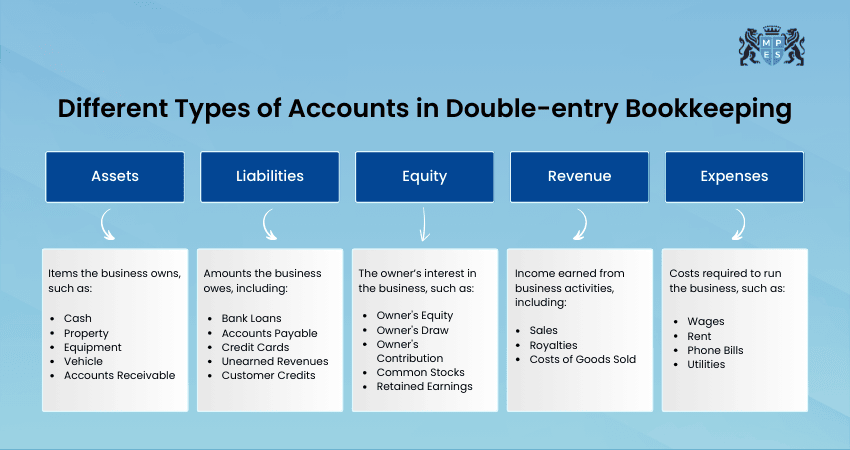
Businesses use accounts to classify transactions, including cash, accounts receivable, accounts payable, sales revenue, and operating expenses.

4. General Ledger: 

The general ledger contains the business’s accounts and records the transactions posted to them.

Examples of Double-Entry Bookkeeping

Understanding practical examples makes the process easier to follow.

1. Recording a sale: 

If a business makes a $500 cash sale, it debits the cash account by $500 and credits the sales revenue account by $500.

2. Purchasing supplies on credit: 

If a business purchases $300 worth of supplies and agrees to pay later, it debits the supplies or relevant expense account by $300 and credits accounts payable by $300.

3. Paying a supplier: 

When the business pays a supplier $300, it debits accounts payable by $300 and credits cash by $300.

These examples demonstrate how every transaction affects multiple accounts while keeping the books balanced.

Benefits of Double-Entry Bookkeeping

Double-entry bookkeeping offers several advantages for businesses.

1. Improves accuracy: 

Recording both sides of each transaction makes it easier to identify discrepancies and maintain consistent financial records.

2. Supports financial reporting: 

The system provides the information needed to prepare key financial statements, including the balance sheet, income statement, and cash flow statement.

3. Helps monitor business performance: 

Business owners can review revenue, expenses, assets, and liabilities to understand their financial position.

4. Strengthens financial control: 

Detailed records help businesses track transactions, reconcile bank accounts, and identify unusual entries.

Conclusion

Double-entry bookkeeping is an essential method for maintaining reliable financial records. By recording every transaction across corresponding accounts, businesses can monitor their financial position, prepare accurate reports, and make better decisions. Establishing consistent bookkeeping practices helps businesses maintain financial transparency and support long-term growth.

0 comments
0 FacebookTwitterPinterestEmail

Hardscape materials play a major role in how a villa garden looks, feels, and performs over time. In Dubai, outdoor surfaces must cope with strong sunlight, high temperatures, dust, water exposure, and frequent use, especially around swimming pools and entertainment areas.

Choosing materials only for appearance can lead to problems later. A better approach is to consider comfort, durability, maintenance, safety, and how each finish works with the rest of the landscape. Thoughtful material selection can make the entire outdoor space feel more consistent and practical.

Start With the Function of Each Area

Different parts of a garden have different requirements. A pool deck may need a surface with suitable grip, while a dining terrace may need something easy to clean and comfortable for regular foot traffic. Experienced landscaping companies in dubai can help homeowners match materials to the way each outdoor zone will be used. Pathways, seating areas, entrances, and garden borders do not necessarily need the same finish.

The aim should be to choose surfaces that suit each function while still creating a visually connected design across the property.

Consider Heat and Comfort Underfoot

Outdoor materials can respond differently to direct sunlight. Some surfaces may become uncomfortable underfoot during warmer parts of the day, especially where people walk barefoot near a swimming pool. Colour, texture, finish, and exposure should all be considered before making a final choice. Shaded areas may allow greater flexibility, while heavily exposed surfaces may require more careful selection.

Homeowners should also think about where people are likely to pause or spend time. A material that works well on a rarely used pathway may not be suitable for a poolside lounge or children’s activity area.

Keep Poolside Surfaces Practical

Pool surrounds need to handle water, cleaning, and regular movement. A polished appearance is not enough if the surface becomes difficult to use when wet. When reviewing swimming pool companies in dubai, homeowners can discuss pool coping, deck materials, drainage, and how the pool edge will connect with nearby terraces or pathways.

The most successful poolside areas often use a limited number of finishes. This helps the water remain the main visual feature while keeping the surrounding space cleaner and less visually busy.

Use a Consistent Material Palette

Using too many different materials can make a villa garden feel fragmented. Paving, wall finishes, steps, pool coping, and decorative surfaces should complement one another even if they are not identical. A limited palette can create a stronger sense of continuity between the villa and the garden. Similar tones or textures can be repeated across different zones to connect spaces naturally.

Consistency also makes future updates easier. If a damaged area needs repair or an additional pathway is added later, working within an established material scheme can help preserve the overall design.

Think About Maintenance Before Installation

Every outdoor surface requires some level of care. Dust, water marks, stains, and everyday wear can affect how materials look over time, particularly in high-use areas. Homeowners should consider how often a surface may need cleaning and whether maintenance will be practical. Highly detailed finishes may look attractive initially but could demand more attention than simpler options.

Accessibility matters as well. Areas around drains, irrigation points, and service routes should remain easy to reach so routine maintenance can be carried out without disturbing large sections of paving.

Balance Hardscape With Planting

Too much paving can make an outdoor space feel harsh, while too much planting may reduce useful living space. A balanced mix usually creates a more comfortable and attractive garden. Planting beds can soften terraces and pathways, while trees and shrubs can provide shade around seating areas. Ground-level greenery can also help break up large expanses of hard surface.

The proportions should reflect how the garden is used. A family that entertains often may need more paved space, while another household may prefer a greener setting with smaller seating areas.

Plan Drainage and Transitions Carefully

Changes between pool decking, pathways, lawns, and planted areas should be designed carefully. Uneven transitions can affect both appearance and everyday movement. Drainage is equally important because water should not collect unnecessarily around seating areas or frequently used routes. The levels of different surfaces need to work together from the beginning. Good planning can make these transitions feel almost invisible. When materials, levels, and edges are coordinated correctly, the entire outdoor area appears more polished and easier to use.

Conclusion

Choosing hardscape materials for a Dubai villa requires more than selecting attractive colours or finishes. Heat, water exposure, comfort, maintenance, drainage, and everyday use should all influence the decision. By matching materials to each outdoor zone and maintaining a consistent palette, homeowners can create a garden that feels connected, practical, and refined. A balanced combination of hardscape and planting can also improve comfort while helping the outdoor space remain manageable over time.

0 comments
0 FacebookTwitterPinterestEmail

Musculoskeletal discomfort can affect work, exercise, sleep and ordinary household activities. When someone explores Chiropractic services, it can be helpful to approach the appointment as one part of a broader conversation about symptoms, movement and everyday habits rather than expecting a single standard solution.

Individual assessment matters because similar symptoms can have different causes. Health history, previous injuries, work demands and current activity levels may all provide useful context. Being prepared to discuss these details can make the consultation more productive.

Track What You Are Experiencing

Before seeking care, pay attention to when symptoms occur and what seems to influence them. You might notice that discomfort changes after sitting, exercise, lifting or certain repetitive tasks.

Brief notes can be useful, especially when symptoms vary from day to day. Avoid trying to diagnose the issue yourself; the purpose is simply to provide a clearer description during the assessment.

Consider Your Daily Routine

Work and lifestyle can involve repeated positions or movements. Long periods at a desk, physical work, driving or frequent lifting may all be relevant to a musculoskeletal discussion.

Explain what a typical day looks like rather than focusing only on the moments when symptoms are strongest. This gives the healthcare professional a broader understanding of the demands placed on your body.

Prepare Questions Before the Appointment

It is easy to forget questions once an assessment begins. Writing down a few points beforehand can help ensure that important concerns are discussed.

You might ask what the practitioner thinks should be evaluated, what the proposed care involves and how progress would be measured. You can also ask when another healthcare professional should become involved.

Understand the Practitioner’s Role

When choosing a Chiropractor, consider professional qualifications, communication and the approach taken to assessment. You should feel able to ask why a particular technique or care plan is being proposed.

No practitioner should discourage appropriate medical evaluation when it is needed. Musculoskeletal care should operate within professional scope, with referral when symptoms require assessment elsewhere.

Discuss Exercise and Movement

Some people reduce nearly all activity when they experience discomfort because they are worried about making the problem worse. Others continue intense exercise despite symptoms that should be assessed.

The appropriate balance depends on the individual situation. Ask whether activities should be modified and whether any specific movement guidance is appropriate based on the assessment.

Avoid Relying on Online Diagnoses

Searching symptoms online can provide general information, but it can also produce long lists of possible conditions ranging from minor to serious. Without an examination, it may be difficult to know what information is relevant.

Use reputable health information to prepare questions rather than reaching a firm conclusion about the cause. Persistent, severe or concerning symptoms deserve appropriate professional evaluation.

Pay Attention to Warning Signs

Some symptoms should not wait for a routine appointment. Significant trauma, rapidly worsening weakness, new neurological symptoms, chest pain or other potentially serious changes may require prompt medical attention.

If you are unsure about the urgency of a symptom, contact an appropriate healthcare service. Seeking timely medical advice is more important than trying to fit every concern into one type of care.

Review Whether the Plan Is Helping

If you attend multiple appointments, periodically discuss what has changed. Consider not only discomfort but also whether daily activities, movement or sleep are improving or becoming more difficult.

Progress should not be assumed simply because time has passed. If there is little change or symptoms worsen, ask whether the plan should be adjusted or whether further evaluation is needed.

Keep Communication Open

Tell the practitioner about concerns, preferences and previous experiences with care. If you do not understand a recommendation, ask for a clearer explanation.

You should have enough information to participate in decisions. Informed involvement can make healthcare feel less like something being done to you and more like a process in which you have an active role.

Conclusion

Managing musculoskeletal concerns begins with paying attention to symptoms and understanding how they interact with everyday activities. Clear descriptions, relevant health information and thoughtful questions can make professional assessments more useful.

It is equally important to recognize when symptoms require additional or urgent medical evaluation. By staying involved in decisions and reviewing progress over time, individuals can take a more informed and practical approach to their musculoskeletal health.

0 comments
0 FacebookTwitterPinterestEmail

Plans are overrated. The best talks often start with nothing, just a button and a little curiosity. A random chat app drops you into a conversation before you have time to overthink it. Someone says hi, you say hi back, and the evening shifts.

Spontaneous talks have their own charm. Nobody has expectations, so everyone relaxes. Here is how to get started, keep things friendly, and protect yourself along the way.

Why Surprise Makes Talks Better

Planned conversations tend to follow a script. You know the topics, the jokes, even the ending. A surprise match throws all that out. You get a new voice, a new story, maybe a joke you have never heard.

That freshness is the whole appeal. Nobody knows your history, so you can try on a different version of yourself for ten minutes. It is a bit like wandering into a shop you never noticed before.

Launching the App the Easy Way

Open the page in your browser or start the app on your phone. Allow any permissions it asks for, and you are nearly done. Most platforms skip long forms, so you can begin in under a minute.

Check your signal before you press start. A weak connection makes every chat choppy. Charge your phone too, since long sessions drain the battery faster than expected. A quiet spot with decent light makes the experience smoother for everyone.

Why People Like Anonymous Chat

Many users pick anonymous chat because it removes pressure. No profile, no photo, no past. You show up as yourself, minus the labels. Shy people often speak more freely when nobody can judge their face or their name.

Still, anonymous does not mean careless. Treat every match like a coin flip. Some click fast, some fade in thirty seconds, and both are normal. Skipping is allowed, and nobody keeps score of your choices.

Easy Openers That Keep Talks Alive

Skip the bare “hi.” Ask what song is stuck in their head, or what they ate for lunch. Small, odd questions get honest answers, and honest answers keep a chat rolling far longer than polite ones.

Listen for one small detail and ask about it. People notice when you remember something they said earlier. Keep your lines short, since long blocks feel like homework. When silence appears, let it breathe, then try a fresh topic.

Staying Safe While Staying Open

Share your first name only. Keep your address, school, workplace, and phone number private. Never send money, however sad the story sounds, and skip any link a stranger offers. Scams often wear a very friendly face.

Adults only, always. If a chat turns rude or pushy, leave right away. You owe nobody an explanation. Use the report button when the site has one. A single click protects you, and it spares the next person a bad surprise.

Knowing When to Log Off

Not every chat needs to last. When replies shrink to one word, wrap it up kindly. A quick “nice talking with you” is plenty. A warm goodbye stays in memory longer than the topic does.

Set a timer so a quick session does not swallow your evening. Stand up, drink water, stretch. Keep real friends close too, since online talks work best as a bonus. If a chat leaves you feeling low, reach out to someone you trust.

Conclusion

Spontaneous talks work because nobody knows what comes next. Bring curiosity, keep your details private, and let the conversation wander. Many chats will fade by dinner. One or two might stay with you for days, which is a nice surprise.

Ready to try? Visit talkwithstranger.com and start whenever the mood hits. Stay kind, stay careful, and keep your manners close. Somebody out there is already waiting to say hello.

0 comments
0 FacebookTwitterPinterestEmail

Story Pin image

Commercial concrete floors often carry decades of hidden history. Old coatings may have been removed, cracks repaired multiple times, machinery relocated, chemicals spilled, and previous patches installed with different materials. By the time a facility plans another flooring upgrade, the slab may contain clues that are not visible during a quick inspection. Understanding this history can help facility managers avoid repeating earlier failures and choose a resinous flooring system based on actual substrate conditions rather than assumptions.

Previous Coatings Reveal Useful Information

An older coating can show where the floor has experienced the greatest stress. Worn forklift lanes, peeling sections, chemical stains, and repeated patches often correspond with specific operating conditions. Instead of viewing the existing surface only as material that needs removal, managers can use it as evidence. Areas that failed earlier may point to moisture, contamination, heavy traffic, poor preparation, or incompatible materials.

Photographs and maintenance records can also help determine whether the same locations have been repaired repeatedly.

Old Repairs Should Be Evaluated

Concrete floors may contain patches installed years apart using different repair products and methods. Some remain firmly bonded, while others begin separating or cracking around their edges.

When comparing Local Epoxy Floor Contractors Nj, facility managers should ask how previous repairs will be assessed once the existing surface is prepared. Weak patches may need removal, while sound repairs might remain depending on their condition and compatibility with the new system. Ignoring unstable repair material can carry old weaknesses into the new installation.

Equipment Relocation Can Expose Hidden Damage

Manufacturing machines, storage racks, refrigerators, workstations, and other fixed equipment can conceal concrete for years. When these items are moved during renovation, previously hidden sections may reveal oil staining, cracks, anchor holes, or older coating systems.

These areas should not automatically receive the same treatment as already exposed concrete. They may require additional cleaning, mechanical preparation, or repair.

A complete assessment becomes easier when managers coordinate equipment movement before final flooring preparation begins.

Contamination Can Remain Below the Surface

Industrial and commercial slabs may have been exposed to oils, grease, coolants, food residues, detergents, or process chemicals over many years.

Even when the visible surface looks clean, contaminants may have penetrated porous or previously unprotected concrete. This can affect adhesion if the substrate is not prepared appropriately.

Mechanical grinding or shot blasting can remove weak material and old coatings while revealing areas that need closer evaluation. Surface preparation should be selected according to slab condition rather than used as a simple checklist step.

Repeated Failures Deserve Investigation

If several coating systems have failed in the same location, applying another one without investigating the pattern is unlikely to be a strong long-term strategy.

Facilities comparing the best epoxy floor contractors should ask how recurring failures will be diagnosed. Moisture conditions, concrete movement, chemical exposure, impact, or inadequate prior preparation may all contribute.

The purpose of the assessment is not simply to identify what material failed, but to understand why the location continues to develop problems.

Floor History Can Influence System Design

A facility’s use may have changed substantially since the previous coating was installed. A warehouse may now handle heavier forklifts, a production area may use different chemicals, or a food-service operation may have introduced more aggressive sanitation procedures.

The replacement flooring system should reflect current and expected future conditions rather than automatically duplicate the old specification.

Managers should provide contractors with information about traffic, equipment, cleaning, spills, and any planned operational changes that may affect the floor.

Documentation Helps Future Maintenance

Once the new installation is complete, managers should begin creating a clearer history for the next maintenance cycle.

Records can include photographs of repaired areas, coating-system information, joint locations, preparation notes, and dates of localized repairs. If deterioration appears later, this documentation helps determine whether a defect is new or connected to a previous substrate condition.

Consistent records can also reveal patterns across high-traffic or chemical-exposure zones.

Inspection Should Continue After Reopening

The first months after installation provide useful information about how the new floor responds to normal operations. Maintenance teams should pay attention to previously problematic locations, including repaired cracks, old equipment zones, joints, drains, and heavily travelled routes. Any unusual changes should be documented early.

Prompt inspection does not mean expecting failure. It simply creates a baseline that makes future condition changes easier to recognize.

Conclusion

Every commercial concrete floor has a history, and that history can influence the success of its next coating system. Previous repairs, hidden contamination, old coating failures, equipment locations, and changing operational demands all provide useful information during renovation planning.

Rather than treating the slab as a blank surface, facility managers can use these clues to guide preparation and system selection. Careful investigation, mechanical preparation, repair evaluation, and maintenance documentation can reduce the risk of repeating past problems and help create a flooring strategy based on what the concrete has actually experienced.

0 comments
0 FacebookTwitterPinterestEmail

Choosing a facial rejuvenation treatment starts with understanding what you want to improve. Skin firmness, texture, and overall facial appearance can change over time, and different non-surgical treatments are designed to address different concerns. If you are comparing a non-invasive face lift Birmingham service with options elsewhere, it helps to understand the technology, treatment goals, consultation process, and expected experience before making a decision.

Understand Your Main Concern

Start by identifying what you would like to improve. Some people are mainly concerned about reduced firmness, while others notice changes in texture, fine lines, or overall facial definition.

A non-invasive treatment may be considered when someone wants a cosmetic approach without traditional surgery. However, different technologies work differently, so the treatment should be selected according to the specific concern.

During a consultation, explain which areas bother you most and what type of improvement you hope to see. This gives the provider useful information when discussing suitable options.

Learn How Treatments Work

When researching non-invasive face lift Birmingham options, ask which technology the provider uses and how it is intended to work.

Different treatments may use energy-based technologies to stimulate changes within targeted skin layers. Treatment methods, sensations, appointment times, and follow-up recommendations can vary.

Rather than comparing treatments only by their names, ask what the technology is designed to address. Understanding the basic process can make it easier to compare services and ask useful questions during a consultation.

Consider Your Skin Condition

Your current skin condition can influence treatment suitability. Skin type, sensitivity, previous cosmetic procedures, and existing concerns may all be relevant.

Tell the provider about recent treatments and the skincare products you regularly use. This information can help them determine whether a particular procedure is appropriate and whether any preparation may be needed.

A professional assessment is also useful when you are unsure whether your main concern involves skin firmness, texture, pigmentation, or another issue.

Compare Treatment Options

Not every non-invasive facial treatment has the same purpose. Some focus primarily on skin tightening, while others may target texture or overall skin appearance.

If you are considering a non-invasive face lift Chattanooga, ask the provider how its treatment differs from other facial rejuvenation options available in the area.

Compare the technology, treatment area, expected number of sessions, recovery considerations, and aftercare requirements. This provides a more useful comparison than focusing only on advertised results.

Ask About Expected Results

Realistic expectations are important with aesthetic treatments. Results can vary depending on the treatment used, individual skin characteristics, and the number of sessions recommended.

Ask when changes may become noticeable and whether improvements are expected gradually or shortly after treatment.

You can also ask how long results may typically remain noticeable and whether maintenance appointments are commonly recommended. Understanding the expected timeline helps you plan without assuming that every person will experience identical results.

Understand the Treatment Experience

Before booking, ask what the appointment will involve from start to finish. The provider should explain how the skin is prepared, how the device or treatment is applied, and what sensations you may experience.

Appointment length can vary depending on the technology and treatment area. Ask how long you should expect to spend at the clinic.

It is also useful to discuss what you may notice immediately afterward. Some treatments may involve temporary redness or sensitivity, depending on the method used.

Review Aftercare Instructions

Aftercare can vary significantly between facial rejuvenation technologies. Ask whether you need to temporarily avoid specific skincare products, sun exposure, heat, exercise, or other activities.

You should also ask what type of skincare routine is recommended after treatment. Following the provider’s instructions can help you care for your skin appropriately during the post-treatment period.

Clear aftercare guidance is a useful part of comparing providers because it shows how much information you can expect before and after your appointment.

Compare Providers Carefully

When comparing non-invasive face lift Birmingham providers, look at the consultation process, treatment information, equipment, staff qualifications, and communication.

A provider should explain the treatment clearly and discuss whether it is suitable for your goals. Be cautious of comparisons based only on promotional photographs or broad claims.

If you are considering a non-invasive face lift Chattanooga, apply the same criteria. Consistent questions can make it easier to compare providers in different locations.

Consider the Overall Investment

Cost is naturally part of the decision, but the initial appointment price does not always represent the full treatment commitment.

Ask what the quoted price includes and whether multiple sessions may be recommended. Find out whether consultation, follow-up, or aftercare guidance is included.

Comparing the complete treatment plan gives you a clearer understanding of what you are considering before making a booking.

Conclusion

A non-invasive facial rejuvenation treatment should be chosen according to your skin concerns, expectations, treatment preferences, and professional assessment. Comparing technology, experience, aftercare, and overall treatment planning can help you make a more informed decision. If you are exploring aesthetic services in Birmingham or Chattanooga, iconicspa.com can be a useful starting point for researching available options. Taking time to understand the treatment before booking can help you choose an approach that aligns with your individual facial rejuvenation goals.

0 comments
0 FacebookTwitterPinterestEmail
Newer Posts