Introduction
Double-entry bookkeeping is an accounting method in which every financial transaction is recorded in at least two accounts. One account receives a debit entry, while another receives a corresponding credit entry. This system helps businesses maintain accurate financial records, track their finances, and identify potential accounting errors.
Unlike single-entry bookkeeping, which records transactions in a simpler format, double-entry bookkeeping provides a more complete picture of a business’s financial position. It is widely used by businesses of different sizes to prepare financial statements and make informed financial decisions.
How Does Double-Entry Bookkeeping Work?
The double-entry system follows a fundamental accounting principle: total debits must always equal total credits. Every transaction affects at least two accounts, ensuring that the accounting equation remains balanced.
The accounting equation is:
Assets = Liabilities + Owner’s Equity
For example, when a business purchases equipment for $2,000 in cash, its equipment account increases by $2,000, while its cash account decreases by the same amount. Both changes are recorded, keeping the accounting records balanced.
Key Components of Double-Entry Bookkeeping
1. Debit:
A debit is recorded on the left side of an account. Depending on the account type, it can increase assets and expenses or decrease liabilities, equity, and revenue.
2. Credit:
A credit is recorded on the right side of an account. It can increase liabilities, equity, and revenue or decrease assets and expenses.
3. Accounts:
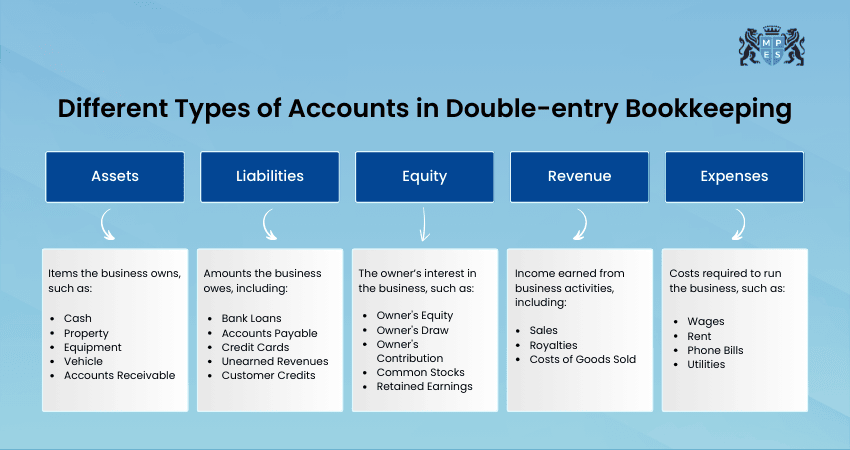
Businesses use accounts to classify transactions, including cash, accounts receivable, accounts payable, sales revenue, and operating expenses.
4. General Ledger:
The general ledger contains the business’s accounts and records the transactions posted to them.
Examples of Double-Entry Bookkeeping
Understanding practical examples makes the process easier to follow.
1. Recording a sale:
If a business makes a $500 cash sale, it debits the cash account by $500 and credits the sales revenue account by $500.
2. Purchasing supplies on credit:
If a business purchases $300 worth of supplies and agrees to pay later, it debits the supplies or relevant expense account by $300 and credits accounts payable by $300.
3. Paying a supplier:
When the business pays a supplier $300, it debits accounts payable by $300 and credits cash by $300.
These examples demonstrate how every transaction affects multiple accounts while keeping the books balanced.
Benefits of Double-Entry Bookkeeping
Double-entry bookkeeping offers several advantages for businesses.
1. Improves accuracy:
Recording both sides of each transaction makes it easier to identify discrepancies and maintain consistent financial records.
2. Supports financial reporting:
The system provides the information needed to prepare key financial statements, including the balance sheet, income statement, and cash flow statement.
3. Helps monitor business performance:
Business owners can review revenue, expenses, assets, and liabilities to understand their financial position.
4. Strengthens financial control:
Detailed records help businesses track transactions, reconcile bank accounts, and identify unusual entries.
Conclusion
Double-entry bookkeeping is an essential method for maintaining reliable financial records. By recording every transaction across corresponding accounts, businesses can monitor their financial position, prepare accurate reports, and make better decisions. Establishing consistent bookkeeping practices helps businesses maintain financial transparency and support long-term growth.